

 Search
 EN
EN Text Size
![[Special issue - Call for papers] Negotiating Legitimacy: Medical Social Work in Clinical Settings across Chinese Societies](/uploads/image/202608/9370ad4cf49af92df15ad74ab9455798.png)
[Special issue - Call for papers] Negotiating Legitimacy: Medical Social Work in Clinical Settings across Chinese Societies
 30 Jun 2027
Learn More



“Financial social work” is an emerging and innovative practice area within the social work profession. Its central mission is to build financial capability and assets for individuals and families, particularly those who are economically vulnerable, with the aim of enhancing financial well-being and promoting broader social development. Through the dedicated efforts of social workers, this field has gradually been systematically integrated into education, research, policy, and practice. In China, although “financial social work” was formally introduced in the 2010s, the concept can be traced back to the early 20th century, including Professor Fei Xiaotong's Peasant Life in China published in the 1930s, as well as the Chinese rural construction movement and practices.
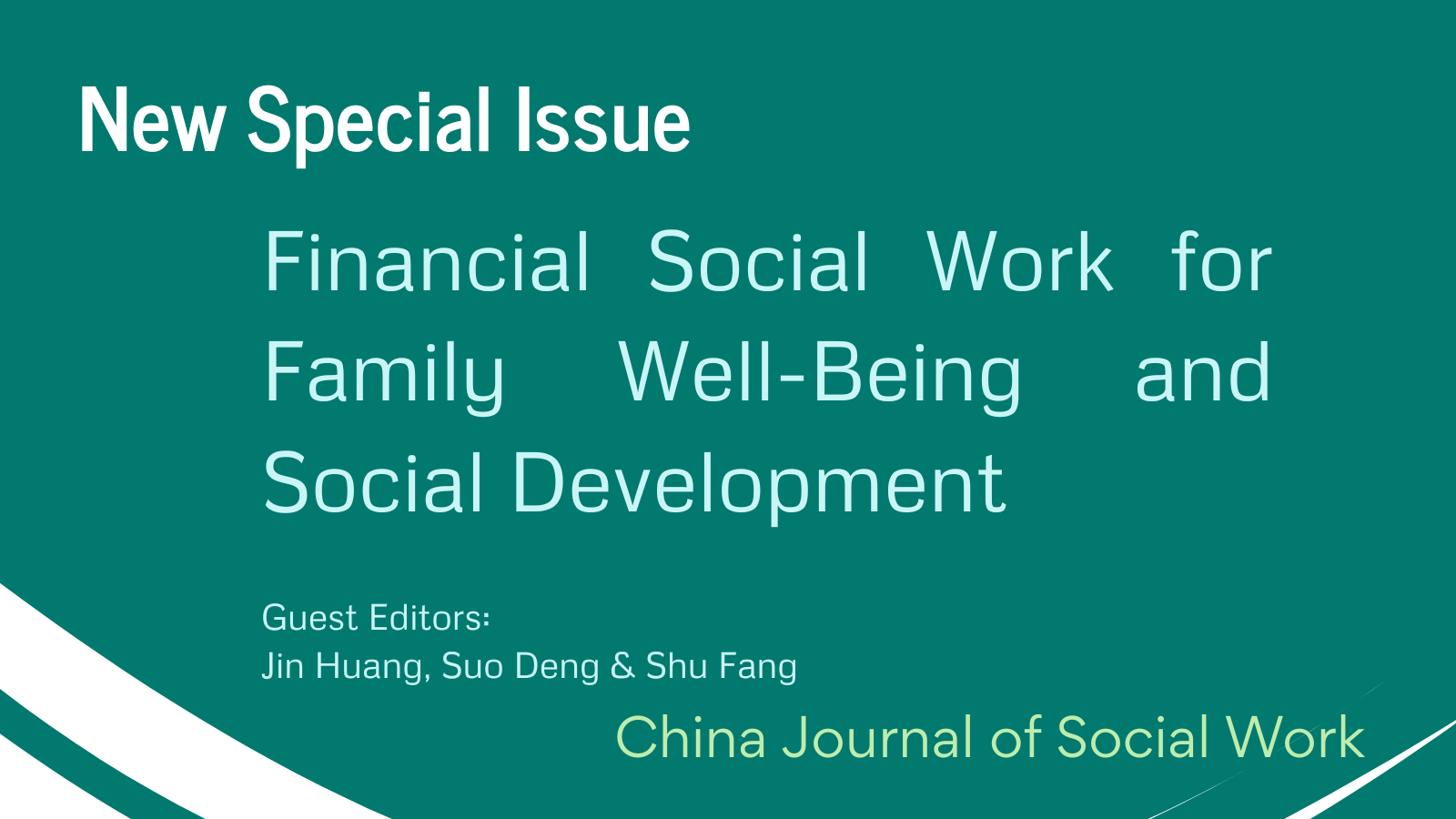
Faced with the complex and ever-changing challenges of the 21st century, the importance and space of “financial social work” in social work and social governance are gradually increasing. To this end, the China Journal of Social Work launches a special issue entitled “Financial Social Work for Family Well-Being and Social Development”. This special issue is co-edited by Jin Huang from Washington University in St. Louis, Suo Deng from Peking University, and Shu Fang from the Central University of Finance and Economics. The papers in this special issue are published across Volume 18, Issue 3 and Volume 19, Issue 1. The five papers in Volume 18, Issue 3 focus on policy architecture, practice models, and practice interventions, whilst the papers in Volume 19, Issue 1 explore issues related to gender, vulnerability, and specific population groups.
Below, we share the abstracts for the articles featured in Volume 18, Issue 3. We invite you to explore these summaries, and you may access the full version of the editorial via the link provided below.
Editorial
Financial social work in China: foundations, frontiers, and global connections
Jin HUANG, Suo DENG & Shu FANG
Link: https://doi.org/10.1080/17525098.2026.2683386
Articles
The JinShe community financial education project: a case study of localised financial social work practice in China
Link: https://doi.org/10.1080/17525098.2026.2648543
Written by Ling ZHOU, Dong ZHANG, Guoyuan ZHANG & Jin HUANG
Abstract: The JinShe Community Financial Education Project launched in 2021. Grounded in the Financial Capability and Asset Building (FCAB) framework, it addresses financial capability gaps among vulnerable populations through a “dual-track empowerment” approach targeting access, knowledge, skills, attitudes, and behaviours. The project established a rigorous “training + supervision + support” financial social worker cultivation system. Service delivery operates through embedded stations employing diverse methods.
As of April 2025, the project expanded to 84 communities across 29 cities. It trained 164 social workers and over 550 volunteers, delivering 950+ activities to 200,000+ residents. Evaluation results show significant improvements: financial capability scores increased by 14.2%, fraud identification accuracy rose from 56.8% to 75.4%, appropriate investment selection increased from 58.7% to 74.8%, and credit card overdue rates declined from 9.1% to 4.0%. The JinShe Project offers a robust model and contribute to a “distinctively Chinese approach” with global applicability.
Child Tax Credit access for low-income families: leveraging VITA under the One Big Beautiful Bill
Link: https://doi.org/10.1080/17525098.2026.2632822
Written by Baorong GUO, Annah BENDER, Sharon D. JOHNSON, Paula MILLER & Ericka JONES
Abstract: H.R.1 (the One Big Beautiful Bill Act), signed into law on 4 July 2025, expands the Child Tax Credit (CTC) by increasing benefit levels and establishing a permanent, inflation-adjusted structure. However, millions of low-income families remain at risk of exclusion due to persistent barriers to tax credit access. As a key practice in financial social work and a cornerstone of social services in the community, the Volunteer Income Tax Assistance (VITA) programme – a proven, IRS-certified, community-based tax service – can play a key role in ensuring that the new CTC reaches families with the greatest need. Policy action is needed to strengthen and expand VITA’s infrastructure, staffing, and outreach capacity.
Building financial resilience: Jordan’s social policies on families’ well-being
Link: https://doi.org/10.1080/17525098.2026.2676555
Written by Rasha ISTAITEYEH
Abstract: This article examines how social policies in Jordan shape the financial well-being of families amid persistent economic pressures, including unemployment, inflation, and regional instability. It analyses key policy areas such as social protection, health care, education, labour market initiatives, microfinance, and financial inclusion, highlighting their effects on household financial stability and long-term resilience. Drawing on international experiences and the concept of Child Development Accounts (CDAs), the article explores how asset-building and financial capability policies could strengthen economic security for Jordanian families, particularly vulnerable groups. The study argues that shifting from short-term assistance toward long-term social investment approaches can enhance financial inclusion, savings behaviour, and economic mobility. The effectiveness of these policies, however, depends on sustained political commitment, institutional coordination, and the ability to adapt to changing socio-economic conditions in Jordan.
Improving nearly-elderly pension well-being via financial social work: analysis on the basis of CHFS2019
Link: https://doi.org/10.1080/17525098.2026.2676553
Written by Liangyu LI, Bangyuan CHEN & Xixi LI
Abstract: Financial social work is a key strategy to improve national financial capacity and public financial well-being. This paper focuses on the pension financial well-being of the 50–60 near-elderly group and its influencing factors. Utilising the 2019 China Household Finance Survey (CHFS) data, Logit and OLS regression models, this study examines how household characteristics, economic status and individual financial behaviour affect pension financial asset holding and returns, and explores feasible financial social work intervention pathways. Findings indicate that, within household characteristics, education significantly positively impacts asset allocation and returns, while health boosts allocation but reduces returns. Within economic status, income positively correlates with allocation, whereas agricultural occupation lowers the likelihood of asset holding. Within individual financial behaviour, fixed deposit holdings significantly and positively affect both outcomes. Accordingly, stratified financial literacy education, financial health support and family asset co-construction are proposed to enhance this group’s pension financial well-being.
Digital inclusion and financial social work: income heterogeneity and charitable engagement among Chinese households
Link: https://doi.org/10.1080/17525098.2026.2659597
Written by Xiao LIANG & Weidi YANG
Abstract: This study examines how household income levels and internet usage interact to influence charitable giving in urban and rural China, using panel data from 2010 to 2022. Employing fixed-effects regression with interaction terms, we found that both low- and high-income households donate more than middle-income households; however, internet usage significantly increases charitable giving among middle-income households. The internet serves as a positive moderator, especially among middle-income groups, by reducing transaction costs and improving donation accessibility. Moreover, urban-rural disparities persist but narrow significantly among internet users. These results underscore the role of digital connectivity and economic resources in shaping charitable values. The results indicate that improving internet infrastructure and reducing income inequality can increase individuals’ inclination to donate and support the advancement of a more equitable society. Importantly, the findings align with the principles of financial social work, which emphasise strengthening individuals’ financial capability, promoting social inclusion, and addressing structural inequalities.
Book Review
Maintaining a sustainable work-life balance: an interdisciplinary path to a better future
Link: https://doi.org/10.1080/17525098.2026.2683383
Edited by Peter KRUYEN, Stéfanie ANDRÉ & Beatrice VAN DER HEIJDEN
Book reviewer: Md. Abu Issa GAZI
![[Special issue - Call for papers] Social Work Practitioners Conducting Research in Chinese Societies: Bridging Theory and Practice in Changing Context](/uploads/image/202606/6fbab7874fd2e78828bcdb6a5ca35ae5.png)