

 Search
 EN
EN Text Size
![[Special issue - Call for papers] Negotiating Legitimacy: Medical Social Work in Clinical Settings across Chinese Societies](/uploads/image/202608/9370ad4cf49af92df15ad74ab9455798.png)
[Special issue - Call for papers] Negotiating Legitimacy: Medical Social Work in Clinical Settings across Chinese Societies
 30 Jun 2027
Learn More



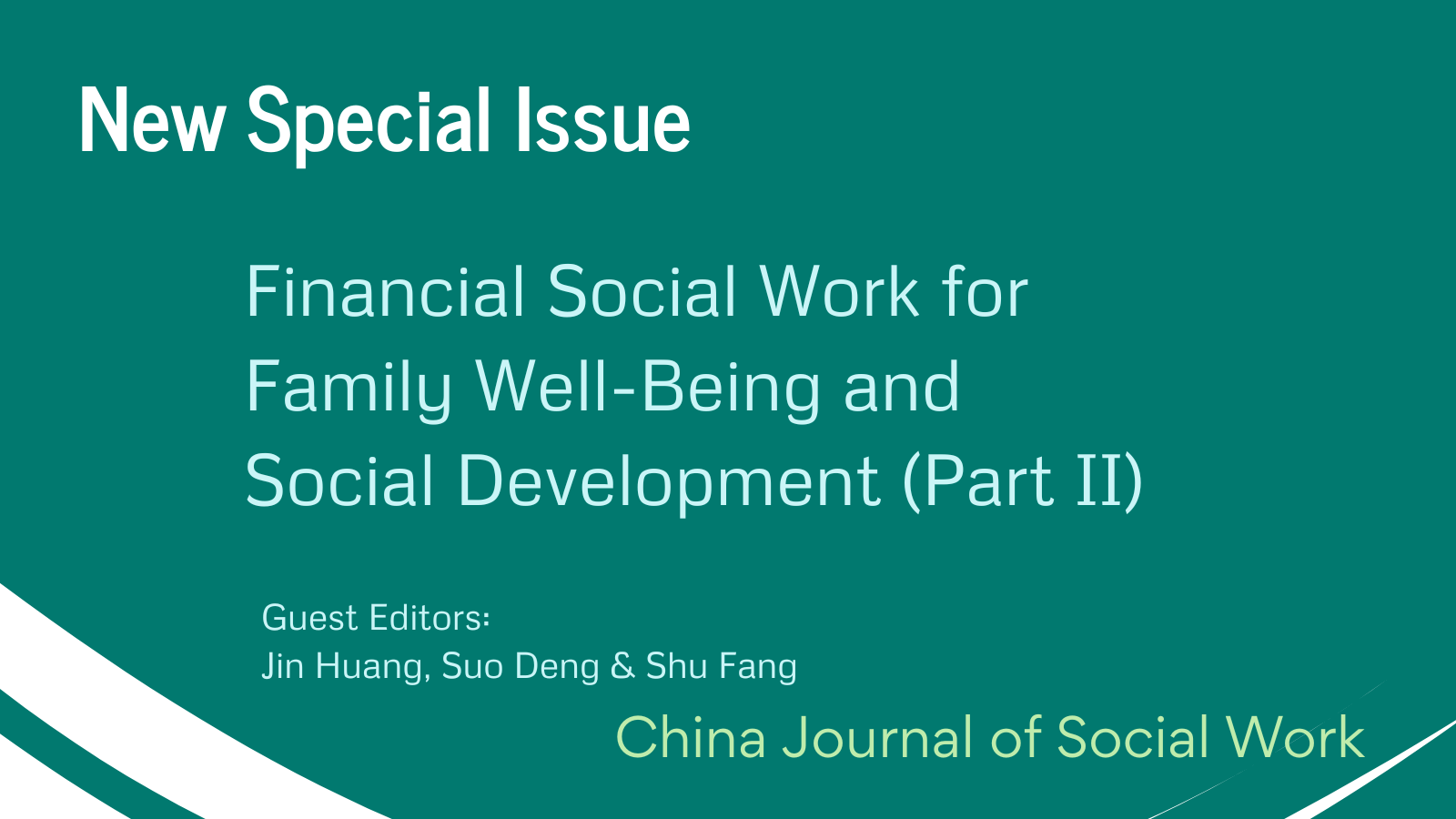
What role can financial social work play in promoting resilience, reducing vulnerability, and fostering inclusive development? This special issue explores these important questions through diverse research and practice perspectives.
The first part of the special issue on “Financial Social Work for Family Well-Being and Social Development” was previously published, focusing on the policy architecture, practice models, and practice interventions. The second part of the special issue was recently published, focusing on issues related to this concept and gender, vulnerability, and specific population groups.
Below, we share the abstracts for the articles featured in Volume 19, Issue 1. We hope these articles inspire further discussion, research, and practice in financial social work.
Articles
Gender disparities in Housing Provident Fund participation in China: an analysis based on propensity score matching
Link: https://doi.org/10.1080/17525098.2026.2639992
Written by Yingying Zhang
Abstract: The Housing Provident Fund (HPF) was designed as a mandatory savings scheme to facilitate housing asset building among employees in China. However, the HPF has long been criticised for its potential role in exacerbating economic inequality. Women may face significant disadvantages in HPF participation and benefits, further reinforcing existing gender disparities in economic security and housing access. To examine this issue, this study employs three propensity score matching (PSM) methods to ensure comparability between male- and female-headed households and uses logistic regression models to examine gender disparities in HPF participation. The Nearest Neighbour Calliper Matching model (β = −0.346, p < 0.01), the Kernel Matching model (β = −0.419, p < 0.01), and the Radius Matching model (β = −0.311, p < 0.01) all indicate that female-headed households (coded as 1) are significantly less likely to participate in the HPF compared to their male-headed (coded as 0) counterparts.
Breaking the cycle: financial self-efficacy, gender ideology, power, and violence against women in China
Link: https://doi.org/10.1080/17525098.2026.2676557
Written by Xiaomin Li
Abstract: This study investigated the complex interplay between financial self-efficacy, relational power, and intimate partner violence (IPV) victimisation and the moderating effects of gender ideologies. Survey data were collected from a sample of 334 abused Chinese women. Results indicated that higher financial self-efficacy was associated with more balanced relational power and in turn with lower levels of IPV victimisation. The gender ideologies of women, their male partners, and interpartner (dis)similarity significantly moderated these relationships. Findings from this study underscore the importance of incorporating financial empowerment, challenging traditional gender norms, and fostering gender-equitable relationships in IPV reduction in the Chinese context.
Individual resilience and financial well-being early in the COVID-19 pandemic: does gender make a difference?
Link: https://doi.org/10.1080/17525098.2026.2648538
Abstract: This study examines the impact of resilience on individuals’ financial well-being (FWB) during the early stages of the COVID-19 pandemic and whether gender differences exist. To achieve this, a cross-sectional survey was conducted with 3,884 volunteer participants in China. The findings are as follows: First, participants’ individual resilience significantly and positively affected their FWB. Second, men’s resilience and FWB were higher than women’s. Third, there were significant gender differences in the impact of resilience on FWB. Therefore, during public health emergencies such as the COVID-19 pandemic, individual resilience is essential, and the implementation of related psychological intervention measures may improve individuals’ FWB.
Financial capability and well-being among migrant workers in post-COVID China: evidence from Hangzhou, Zhejiang Province
Link: https://doi.org/10.1080/17525098.2026.2648539
Written by Yingying Zeng, Fan Chen, Yutian Chen & Min Hu
Abstract: While many migrant workers had made significant financial progress over the past decades, the COVID-19 pandemic disrupted migration patterns and employment opportunities, putting the progress they had made at risk. This study examines the financial capability and well-being of migrant workers in Hangzhou, an industrial hub with a large migrant workforce. Using original survey data collected from 664 migrant workers in two communities with high migrant worker populations between January and March 2025, we investigated the relationship between different dimensions of financial capability–financial knowledge, access to financial services, and digital financial literacy–and financial well-being. We found that both financial access and digital financial literacy were positively associated with financial well-being, which highlighted the importance of strengthening financial capability–especially in digital contexts–as a protective factor for migrant workers’ economic resilience in times of crisis, with implications for policy and intervention efforts aimed at promoting financial inclusion and stability.
Book Review
Shehuigongzuo lilun: lishi huanjing xia shehuifuwu shijianzhe de shengyin he zhihui [Social work theory: voice and wisdom of social service practitioners in historical environment]
Link: https://doi.org/10.1080/17525098.2026.2685114
Written by Min Tong
Book reviewer: Haiping Chen
Back Matter
Word of Appreciation to Manuscript Reviewers
Link: https://doi.org/10.1080/17525098.2026.2694661
Written by Juan Chen & Sibin Wang
![[Special issue - Call for papers] Social Work Practitioners Conducting Research in Chinese Societies: Bridging Theory and Practice in Changing Context](/uploads/image/202606/6fbab7874fd2e78828bcdb6a5ca35ae5.png)